
Serverless and Cost Efficiency
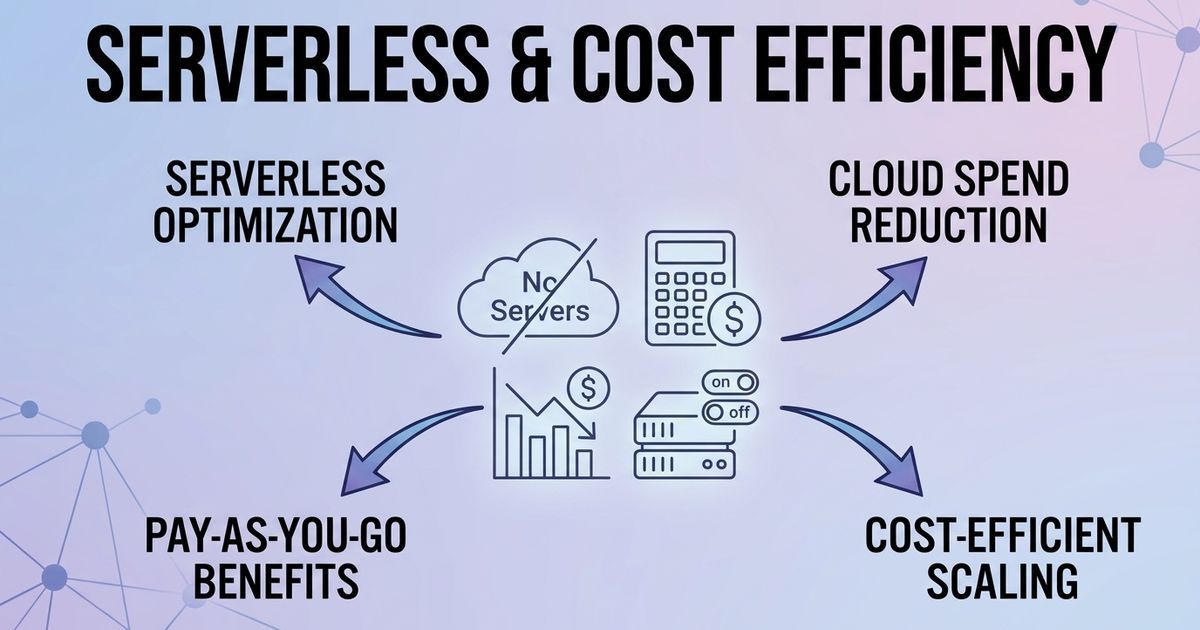

Serverless and Cost Efficiency: What Leaders Should Ask Before Migrating
A single serverless function stuck at its maximum timeout setting can cost 180 times more than the same function configured correctly for its actual workload. Serverless genuinely delivers the cost savings it promises — but only for organizations that ask the right questions before migrating, not after the first surprising bill arrives.
Not sure if serverless is the right fit for your workloads — or your cost governance?
Serverless computing is frequently pitched to leadership with a simple, appealing story: pay only for what you use, no infrastructure to manage, automatic scaling. That story is accurate, and the underlying economics genuinely work — but the size of the payoff depends heavily on a factor rarely mentioned in the initial pitch: whether the organization has the cost monitoring discipline to actually capture the savings the model makes possible.
Stats That Matter
- A multi-year study of real-world serverless deployments found an average of 35% annual cost savings, with a 5-year cumulative net savings of $11.5 million across the organizations examined.
- Deloitte research found systems maintenance time drops by a factor of eight with serverless adoption, substantially reducing operational overhead beyond the direct compute savings.
- 43% of organizations struggle with serverless monitoring complexity, and 39% lack accurate cost visibility across multi-cloud serverless deployments — precisely the gap that determines whether the promised savings materialize or quietly evaporate.
Why the Pay-Per-Use Model Cuts Both Ways
The core appeal of serverless — paying precisely for what you use, down to fine-grained execution time — is also its central risk if left unmonitored. This pricing model rewards efficient, well-tuned workloads generously, but it penalizes poorly configured ones just as sharply, and the penalty compounds silently without triggering the kind of visible alarm a traditional infrastructure overspend might.
A function configured with an excessive timeout setting, for instance, can end up costing dramatically more than the same function properly tuned for its actual execution time — sometimes by two orders of magnitude. Multiplied across hundreds of functions in a mature serverless deployment, small individual misconfigurations compound into a significant, difficult-to-trace source of waste that doesn't show up as a single obvious line item.
Where Serverless Delivers Its Strongest Returns — And Where It Doesn't
The pattern in the data is clear and worth internalizing before leadership approves a broad serverless migration: serverless excels specifically for event-driven workloads, intermittent traffic, and utilization patterns below roughly 30% — situations where traditional infrastructure sits idle much of the time and pay-per-use pricing eliminates that waste entirely. The same pricing model that delivers dramatic savings for low-traffic functions becomes comparatively expensive for continuous, high-volume workloads that would run more cheaply on dedicated, reserved infrastructure.
This means the leadership question isn't "should we adopt serverless" as a blanket strategy — it's "which specific workloads have the traffic pattern that makes serverless economically favorable, and which don't." Applying serverless uniformly across all workloads, regardless of traffic pattern, is a common way organizations undermine the very cost efficiency they were trying to capture.
The Hidden Benefit Beyond the Compute Bill
The direct cost savings, while significant, aren't even the full picture leadership should weigh. Organizations report systems maintenance time dropping by a factor of eight after serverless adoption — a substantial reduction in the operational overhead of patching, scaling, and managing underlying infrastructure. This frees engineering capacity for higher-value work rather than infrastructure upkeep, which connects directly to the engineering culture and velocity themes covered elsewhere in this series: less time spent on infrastructure maintenance is more time available for the work that actually differentiates the business.
Why Monitoring Complexity Is the Real Barrier, Not the Technology
The organizations that struggle with serverless economics almost never struggle because the underlying technology failed to deliver savings — they struggle because they didn't build the monitoring and cost governance discipline needed to see where those savings were leaking. A meaningful share of organizations report real difficulty with serverless monitoring complexity, and a comparable share lack accurate cost visibility once serverless functions span multiple cloud providers or services.
This is a direct continuation of the FinOps and cloud accountability challenge discussed elsewhere in this series — serverless doesn't eliminate the need for cost governance, it just changes its shape. Instead of tracking a fixed number of servers, an organization now needs to track potentially thousands of individual function executions, each with its own configuration and cost profile.
What Successful Organizations Do Differently
They treat serverless FinOps as a day-one practice, not a retrofit after the bill arrives. Organizations implementing cost governance from the start of a serverless migration consistently outperform those that wait until costs become a visible problem to build monitoring discipline.
They measure total cost of ownership, not just the per-execution charge. Comparing serverless purely against the sticker price of a Lambda invocation or equivalent misses the operational overhead savings on one side and the monitoring tooling investment needed on the other. The complete comparison includes both.
They make development teams accountable for the costs their code generates. Chargeback mechanisms that connect a team's serverless spend visibly back to their own architecture decisions create the same kind of unit-economics accountability discussed elsewhere in this series as essential to controlling cloud waste generally.
They match workload type to serverless suitability deliberately, rather than adopting it universally. Event-driven, intermittent workloads are a strong fit. Continuous, high-volume workloads frequently are not, and forcing them into a serverless model out of architectural enthusiasm rather than genuine cost fit undermines the business case.
What Leadership Should Ask Before the Next Serverless Migration Decision
Does this specific workload have the traffic pattern that makes serverless economically favorable, or are we assuming the benefit applies universally? Not every workload benefits equally, and treating serverless as a default strategy rather than a targeted one erodes the savings case.
Do we have monitoring and cost visibility in place before migration, or are we planning to add it after we see the bill? The organizations struggling most with serverless economics are consistently the ones that treated cost governance as an afterthought rather than a prerequisite.
Are development teams accountable for the cost consequences of their configuration choices? Without that accountability, the kind of costly misconfigurations that quietly compound — like an oversized timeout setting — tend to go unnoticed until they've accumulated into a real problem.
Key Takeaways
- Real-world serverless deployments show an average of 35% annual cost savings and an 8x reduction in maintenance time, but these gains depend heavily on disciplined cost monitoring.
- Serverless economics reward well-tuned, event-driven, intermittent workloads and penalize poorly configured or continuously high-volume ones — it is not a universally superior model for every workload.
- A significant share of organizations struggle with serverless monitoring complexity and multi-cloud cost visibility, which is the primary reason expected savings fail to materialize.
- The strongest results come from treating cost governance as a day-one practice built alongside the migration, not a response to an unexpectedly high bill.
- Leadership should evaluate serverless adoption workload by workload, based on traffic pattern and monitoring readiness, rather than as a blanket infrastructure strategy.
What to Do Next
If your organization is considering a serverless migration, or already running serverless workloads without clear cost visibility, that's the exact gap where expected savings tend to quietly disappear.
I work with a trainer who specializes in exactly this: helping leadership and technical teams build the cost governance discipline that turns serverless adoption into real, measurable savings rather than an unpredictable bill. If this is on your radar for the next quarter, call or contact me and I'll help you get started.